
Shawn Freeman
CEO


Running a small business means juggling countless responsibilities, from serving customers to managing finances to keeping employees productive. The last thing you need is technology headaches slowing you down. Yet for many business owners, IT problems consume valuable time and energy that should be focused on growth. That's where managed technology services come in-a partnership model that takes the burden of technology management off your shoulders while keeping your systems secure, efficient, and ready to scale.
Managed services represent a fundamental shift from reactive IT firefighting to proactive technology partnership. Instead of calling someone only when things break, you get continuous monitoring, maintenance, and strategic guidance.
Think of it this way: you wouldn't wait for your car to break down on the highway before getting an oil change. Similarly, managed technology services prevent problems before they disrupt your business. This proactive approach saves money, reduces downtime, and eliminates the stress of unexpected tech emergencies.
Managed technology services encompass a comprehensive range of support functions designed to handle every aspect of your IT infrastructure:
The real value isn't just in fixing problems-it's in the peace of mind knowing experts are watching over your technology infrastructure while you focus on what you do best.

Many business owners have experienced the frustration of traditional break-fix IT support. You call when something breaks, wait for someone to show up, pay by the hour, and cross your fingers that the same problem won't happen again next week.
| Traditional Break-Fix IT | Managed Technology Services |
|---|---|
| Reactive-waits for problems | Proactive-prevents issues |
| Unpredictable costs | Fixed monthly investment |
| No ongoing relationship | Strategic partnership |
| Patchwork solutions | Comprehensive ecosystem |
| Limited accountability | Service level agreements |
The managed IT support model creates alignment between you and your technology partner. When your provider succeeds by keeping your systems running smoothly rather than billing for problems, everyone wins.
Consider a typical scenario: your server crashes on a Friday afternoon. With traditional IT support, you're looking at emergency rates, rushed diagnostics, and potentially hundreds or thousands in unexpected costs-right when you need to process payroll or fulfill customer orders.
With managed technology services, that scenario doesn't happen. Continuous monitoring would have detected warning signs weeks earlier. Automated updates would have patched vulnerabilities. Redundant systems would have ensured business continuity even if hardware failed.
The math is straightforward. According to industry research, businesses using managed technology services experience 40-50% less downtime than those relying on break-fix support. For a company with 20 employees earning an average of $25 per hour, just one day of downtime costs $4,000 in lost productivity-not counting missed opportunities and frustrated customers.
Starting a relationship with a managed technology services provider should feel like gaining a trusted advisor, not just another vendor. The best providers take time to understand your business before proposing solutions.
Month one typically focuses on discovery and assessment. Your provider will:
This initial IT audit process provides clarity about where you stand and what needs attention. You'll likely discover issues you didn't know existed-outdated software creating security risks, inefficient processes wasting time, or equipment that should have been replaced years ago.
Months two through six involve systematic improvements while maintaining daily operations. Think of it as renovating a house while you're still living in it-changes happen gradually, minimizing disruption while steadily improving your technology environment.
Once fully onboard, most interactions with your managed technology services provider happen behind the scenes. Remote monitoring and management tools constantly check your systems, applying updates, backing up data, and addressing minor issues automatically.
When your team does need help, they have multiple ways to get support:
The response time depends on priority level. A single user who can't print gets help within a few hours. An email server outage affecting everyone gets immediate attention.

Not all managed technology services providers offer the same capabilities. Understanding what's available helps you choose the right partner and get maximum value from the relationship.
Small businesses increasingly face the same cyber threats as large corporations, but with fewer resources to defend themselves. A comprehensive cybersecurity approach should include:
The threat landscape changes daily. What worked last year won't protect you in 2026. Managed technology services providers stay current on emerging threats and adjust defenses accordingly-something most internal IT staff can't manage alongside their other responsibilities.
Cloud migration isn't about following trends-it's about gaining capabilities that were once available only to enterprise companies. Modern managed technology services leverage cloud platforms for:
Whether you're fully cloud-based, hybrid, or still primarily on-premises, the right provider helps you maximize these tools without the complexity.
The most valuable aspect of managed technology services often isn't technical-it's strategic. Regular business reviews with your provider should answer questions like:
Is our technology supporting growth? If you plan to add employees or open new locations, what infrastructure changes are needed?
Are we spending wisely? Which subscriptions aren't being used? Where could we consolidate vendors?
What opportunities are we missing? Could automation eliminate repetitive tasks? Would better collaboration tools improve team efficiency?
This strategic perspective transforms IT from a cost center into a competitive advantage.
The managed technology services market offers hundreds of options, making selection challenging. Focus on factors that indicate long-term partnership potential rather than just technical capabilities.
When evaluating providers, ask about their approach to common scenarios:
"What happens if I need help outside business hours?" You want a provider with actual 24/7 support, not an answering service that takes messages.
"How do you stay current on cybersecurity threats?" Look for specific certifications, training programs, and industry participation rather than vague assurances.
"Can you support our specific technology stack?" If you use Macs, Google Workspace, or industry-specific software, ensure the provider has relevant expertise. Many providers focus exclusively on Windows and Microsoft, leaving Mac users and Google Workspace organizations underserved.
"What's your approach to contracts?" Some providers require long-term commitments, while others offer month-to-month flexibility. Best practices in the managed services industry emphasize client satisfaction over contractual locks.
Certain warning signs suggest a provider might not deliver the experience you need:
Trust your instincts. If something feels off during the sales process, it probably won't improve after you sign up.
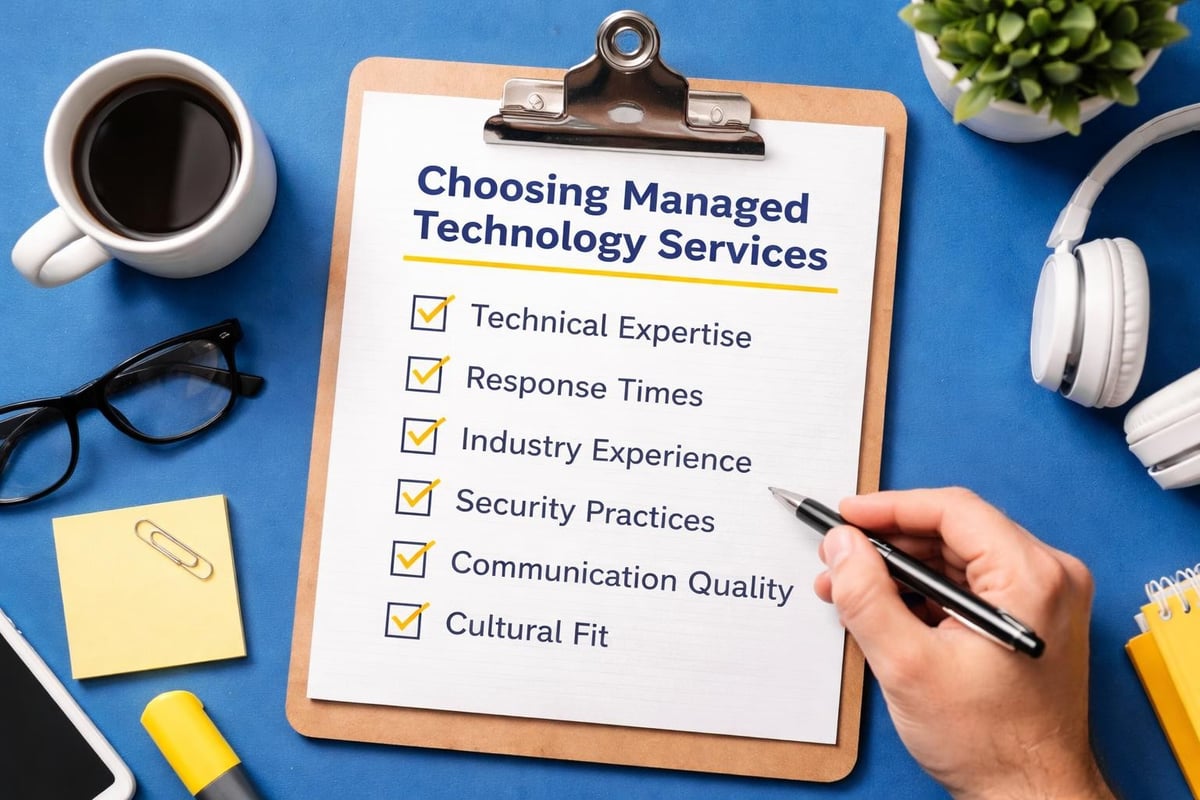
Understanding how managed technology services address real business problems helps clarify the value proposition beyond abstract benefits.
The problem: Your team spends hours each week struggling with technology instead of serving customers or completing projects. Passwords get forgotten, software behaves strangely, printers refuse to cooperate-death by a thousand small frustrations.
The solution: Responsive help desk support resolves these issues in minutes instead of hours. Even better, proactive management prevents many problems from occurring. Automated password resets, regular maintenance, and user training reduce friction points that slow productivity.
The problem: You read about ransomware attacks and data breaches constantly. You know your business could be a target, but you don't know if your defenses are adequate or where to start improving them.
The solution: Comprehensive cybersecurity services provide multiple layers of protection and regular security assessments. You get expert guidance on compliance requirements, employee training to prevent social engineering, and incident response plans so you know exactly what to do if something happens.
The problem: Every vendor claims their solution is essential. You can't tell which investments will actually help your business and which are expensive distractions.
The solution: Strategic IT planning sessions help prioritize technology investments based on your actual needs and budget. Your managed technology services provider becomes a trusted filter, recommending solutions that genuinely address your challenges rather than chasing the latest trends.
The problem: Some months you spend nothing on IT. Other months, emergency repairs and urgent upgrades create budget chaos. You can't plan effectively when technology expenses are unpredictable.
The solution: Fixed monthly pricing creates budget predictability. You know exactly what technology will cost each month, making financial planning simpler. More importantly, proactive maintenance prevents the emergencies that generate surprise bills.
The managed technology services landscape continues evolving rapidly. Understanding current trends helps you select a provider positioned for the future, not stuck in outdated approaches.
Advanced providers now use AI-powered tools for:
These capabilities don't replace human expertise-they augment it, allowing technicians to focus on complex problems while automation handles routine tasks.
The remote work transformation that accelerated during the pandemic has permanently changed technology requirements. Leading managed service providers now excel at supporting distributed teams through:
Whether your team works from the office, home, or a mix of both, your technology should enable productivity rather than create obstacles.
Generic IT support increasingly gives way to industry-specific expertise. Healthcare practices need HIPAA compliance knowledge. Law firms require understanding of legal technology and client confidentiality. Creative agencies benefit from specialists who understand Mac workflows and design software.
When evaluating providers, consider whether they understand your industry's unique challenges and regulatory requirements.
Success with managed technology services requires active partnership, not passive consumption. The best outcomes happen when you engage strategically with your provider.
Define success metrics that matter to your business. Is it response time? Uptime percentage? Cost savings? Employee satisfaction? Your provider should track and report on these regularly.
Establish communication preferences. Do you want weekly check-ins or monthly reviews? Email updates or dashboard access? The right communication cadence keeps everyone aligned without creating meeting overload.
Identify your internal IT champion. Even with external support, someone in your organization should serve as the primary contact and decision-maker for technology matters.
Many businesses underutilize their managed technology services relationship. Beyond reactive support, ask your provider to:
Working effectively with your IT service provider means treating them as a strategic partner rather than just a technical resource.
Technology changes constantly, but you don't need to become an expert. Your provider should:
The goal is informed decision-making, not information overload.
What distinguishes exceptional managed technology services from merely adequate support? It comes down to philosophy, expertise, and commitment.
Flexibility matters. Some providers lock clients into multi-year contracts, betting that switching costs will keep you from leaving even if service deteriorates. The best providers earn your business monthly through excellent service, not contractual obligations. Month-to-month arrangements demonstrate confidence in value delivery.
Expertise in diverse environments matters. If your team uses Macs, you need a provider who genuinely understands Apple ecosystems, not Windows specialists trying to adapt. Similarly, Google Workspace organizations require different expertise than Microsoft 365 shops.
Human-first service matters. Technology exists to help people work better. Providers who remember this create better experiences than those focused exclusively on technical metrics. When you call for help, you should talk to a knowledgeable person who explains things clearly, not get bounced through endless phone trees.
Proactive security matters. MSP best practices emphasize preventing problems rather than just responding to them. Your provider should identify and address vulnerabilities before they're exploited, not wait for a breach to recommend improvements.
Going beyond expectations matters. The name "Always Beyond" reflects a philosophy of exceeding standards rather than meeting minimums. Whether that means responding faster than required, solving problems outside typical scope, or simply making technology less stressful for busy business owners, exceptional service creates lasting value.
Managed technology services transform IT from a source of frustration into a strategic advantage, giving small businesses enterprise-grade support without enterprise budgets or complexity. By partnering with the right provider, you gain not just technical support but peace of mind, knowing experts are protecting your systems, supporting your team, and helping your business grow. If you're ready to experience IT support that actually works the way it should-responsive, proactive, and built around your needs-Always Beyond offers a free consultation to assess your current technology environment and show you what's possible without contracts, pressure tactics, or confusing jargon.
See exactly how your current IT setup measures up to our Hack Free standards. Enter your business email to receive:
