
Shawn Freeman
CEO


Understanding managed service provider pricing can feel like solving a puzzle without all the pieces. If you're a small business owner trying to budget for IT support in 2026, you've probably encountered wildly different quotes and wondered why one provider charges $99 per user while another wants $2,500 per month as a flat fee. The truth is, managed service provider pricing has evolved significantly, and knowing how providers structure their fees can save you thousands of dollars while ensuring you get the support your business actually needs.
The landscape of managed IT services pricing has matured considerably over the past decade. Most providers have moved away from break-fix billing (charging hourly for repairs) toward predictable monthly fees that cover ongoing support and maintenance.
The shift happened for a good reason. Break-fix models incentivized providers to fix problems after they occurred rather than preventing them in the first place. Monthly managed service provider pricing aligns everyone's interests: providers focus on keeping your systems running smoothly because that's more efficient than constantly fighting fires.
Today's popular pricing models for managed services providers typically fall into these categories:
Per-User Pricing:
Per-Device Pricing:
Tiered Packages:
All-Inclusive Flat Fee:
Customized Hybrid Models:
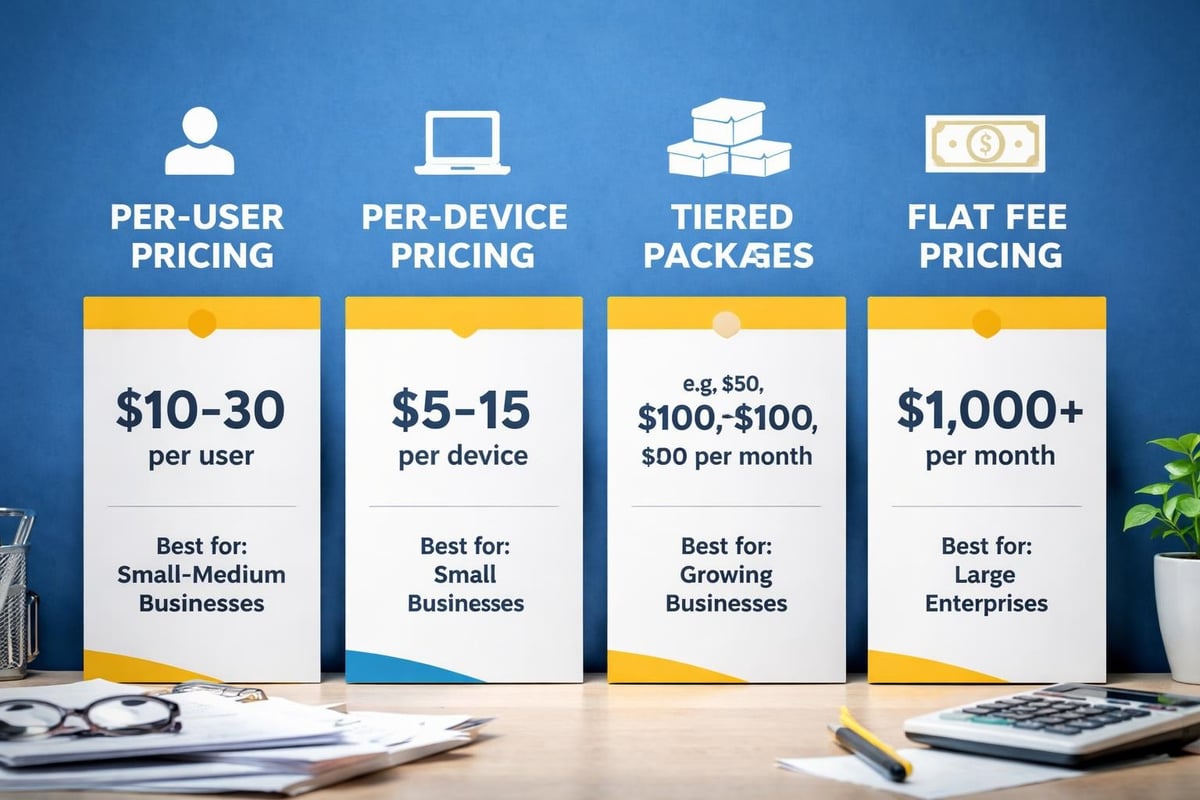
| Pricing Model | Average Monthly Cost | Best For | Main Advantage |
|---|---|---|---|
| Per-User | $75-$250/user | Standard office environments | Scales with headcount |
| Per-Device | $50-$175/device | Equipment-heavy businesses | Precise device tracking |
| Tiered Packages | $500-$5,000+ total | Businesses wanting clear options | Easy to understand |
| Flat Fee | $1,500-$10,000+ | Organizations needing budget certainty | Maximum predictability |
| Hybrid | Varies widely | Complex or unique situations | Complete customization |
The sticker price only tells part of the story. Several factors determine what you'll actually pay for managed IT services, and understanding these helps you evaluate whether a quote is fair.
Your business size matters, but not just in employee count. A 20-person architecture firm with powerful workstations and large file transfers has different needs than a 20-person consulting firm primarily using cloud software. The complexity of your technology environment significantly impacts managed service provider pricing.
Industry requirements play a major role. Healthcare practices need HIPAA compliance monitoring. Financial services require enhanced security protocols. Legal firms need secure document management. These specialized requirements increase costs because they demand additional expertise and tools.
Technology Stack Complexity:
Most providers structure managed service provider pricing around common business environments running Windows, Microsoft 365, and standard business applications. If you're running specialized software, legacy systems, or mixed Mac and PC environments, expect pricing adjustments.
Always Beyond, for example, offers specialized Mac support that many providers charge extra for or can't handle at all. This expertise in both Mac and PC environments means businesses don't need multiple IT vendors.
Response Time Expectations:
Do you need 24/7 emergency support, or is next-business-day response acceptable? The evolution of pricing models shows that faster guaranteed response times typically increase monthly fees by 20-40%.
Most small businesses don't actually need round-the-clock support for every issue, but they do need critical systems protected. Smart managed service provider pricing structures tier response times by severity: immediate response for security incidents and server outages, faster response during business hours for productivity issues.
Current State of Your Systems:
If your infrastructure is outdated, poorly documented, or already experiencing problems, expect initial costs for assessment and remediation. Some providers build this into their onboarding fees, while others spread it across the first few months of service.
The IT audit process reveals exactly what you're working with and helps providers give accurate pricing rather than lowball estimates that increase later.
Here's where managed service provider pricing gets murky. Two providers might charge similar amounts while delivering vastly different services. Understanding what "managed IT services" actually includes helps you compare apples to apples.
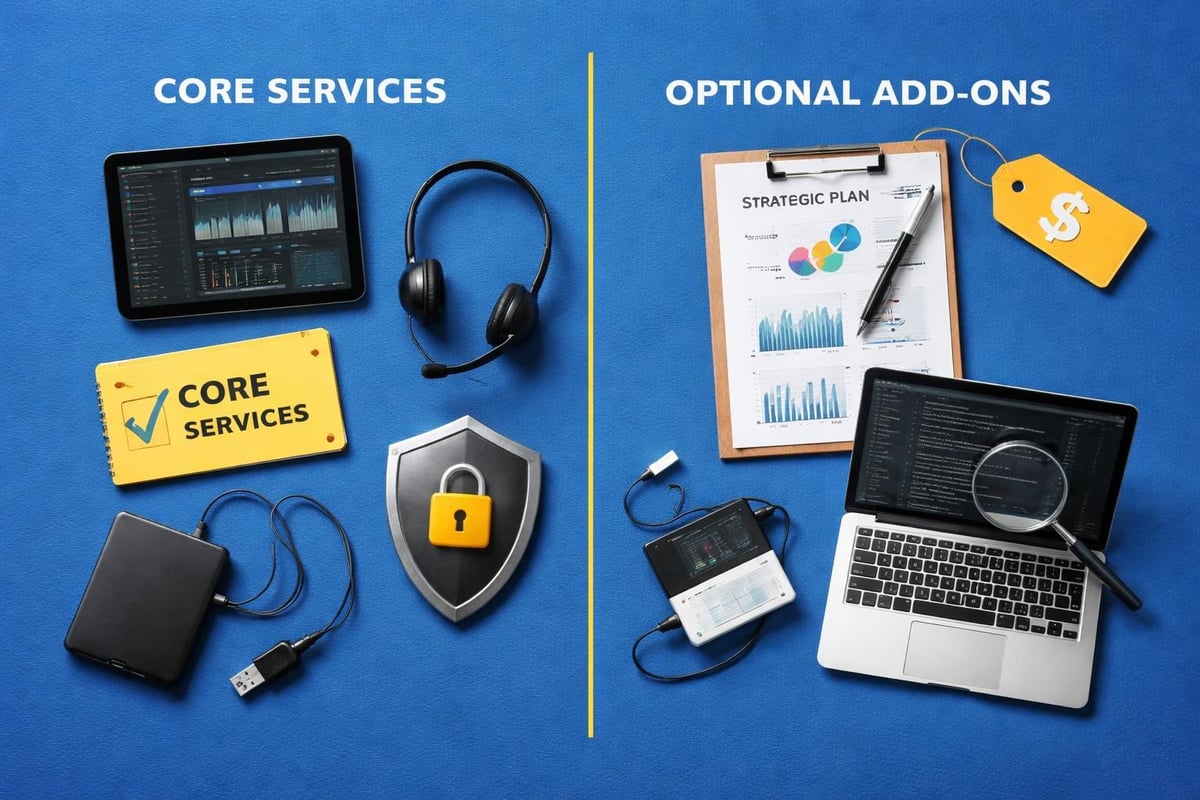
At minimum, comprehensive managed services IT support should cover these areas:
These basics keep your technology running, but they're just the foundation. Many businesses need additional services that some providers include while others charge extra for.
Services That Are Sometimes Extra:
The difference between a $100/user and $200/user managed service provider pricing structure often comes down to which of these "extras" are included versus billed separately.
Let's look at what businesses are actually paying. According to managed IT services cost data, the average small business spends between $1,500 and $8,000 monthly on managed IT support.
That's a massive range. Here's what drives a business toward the lower or higher end:
Lower End ($1,500-$3,000/month):
Mid-Range ($3,000-$6,000/month):
Higher End ($6,000-$15,000+/month):
A medical practice with 12 employees might pay more than a 25-person marketing agency because of HIPAA requirements, electronic health records systems, and the critical nature of their technology. Context matters enormously in managed service provider pricing.
| Service Component | Cost | Notes |
|---|---|---|
| Base per-user fee (20 users) | $2,400 | $120/user including monitoring, support, updates |
| Enhanced cybersecurity | $800 | Advanced threat detection and response |
| Microsoft 365 management | $300 | License optimization, user training, admin tasks |
| Google Workspace support | $200 | Always Beyond specialty for mixed environments |
| Backup service | $250 | Cloud backup with monthly verification |
| Monthly strategic consultation | $0 | Included, not billed separately |
| Total Monthly Investment | $3,950 | Predictable, all-inclusive support |
This example shows how managed service provider pricing builds up. The business gets comprehensive support for under $200 per employee monthly-far less than hiring even one full-time IT person.
When evaluating managed service provider pricing, the lowest quote rarely delivers the best value. Some providers deliberately underbid to win contracts, then make money through hidden fees, slow service, or encouraging expensive hardware upgrades.
Here's what typically happens with suspiciously low pricing:
Limited Scope of Work:
The contract covers only specific systems or issues. Everything else becomes a billable project. That $75/user fee seems great until you're paying $150/hour for "out of scope" work that happens constantly.
Reactive Instead of Proactive:
Cheap providers often skip the monitoring and maintenance that prevent problems. They're essentially running a glorified break-fix model under a managed service agreement label. Your monthly fee gets you access to help when things break, but nothing to stop the breaking.
Understaffed Support Teams:
Low managed service provider pricing often means the provider is stretched thin. You'll experience long wait times, tickets that sit for days, and technicians who don't have time to understand your business. The statistics on managed services show that provider profitability directly correlates with service quality.
Hidden Costs and Surprise Fees:
Watch for contracts that exclude common needs like after-hours support, on-site visits, software licensing assistance, or strategic planning. These "extras" can double your actual costs.
Always Beyond takes a different approach with no-contract flexibility that reflects confidence in service quality rather than locking clients into agreements they might regret.
You've received three quotes ranging from $2,000 to $6,500 per month. Now what? Here's a systematic approach to comparing managed service provider pricing:
Build a spreadsheet listing every service you need, then check which proposals include each item. Don't just compare total monthly fees.
Questions to Ask Every Provider:
Some providers will give you vague answers. That's a red flag. Managed service provider pricing should be transparent and detailed.

Many providers offer discounted first-year pricing to win your business, then increase fees substantially in year two. Ask directly: "What increases should I expect after the initial term?"
Annual increases of 3-5% to account for rising costs are reasonable. Jumps of 20-30% or more suggest the initial pricing was artificially low. According to 2026 cost projections, managed service provider pricing is trending upward due to increased security threats and labor costs, but the increases should be gradual and communicated clearly.
Don't focus solely on the monthly managed services fee. Consider:
A slightly higher monthly fee with everything included often costs less overall than a bare-bones package requiring constant additional purchases.
Traditional managed service provider pricing typically involves one to three-year contracts with termination penalties. This made sense when providers needed to amortize setup costs and couldn't afford client churn.
Today, some forward-thinking providers operate without long-term contracts. This signals confidence in their service quality. If you're not happy, you can leave. That's a powerful motivator for the provider to consistently deliver value.
Always Beyond's no-contract approach reflects this philosophy. The relationship continues because it's genuinely valuable, not because you're locked in. This flexibility particularly benefits growing businesses whose needs change rapidly.
When reviewing managed service provider pricing agreements, clarify:
What happens if we outgrow your services? Can you scale up quickly, or will we hit a wall where we need to switch providers?
What if we need to reduce services temporarily? Economic downturns happen. Can you adjust services and pricing, or are you locked into paying for support you're not using?
How quickly can we add or remove users/devices? Monthly billing adjustments should be standard, not quarterly or annual.
What's the process for ending the relationship? A good provider makes this clear and straightforward, even if they hope you'll never use it.
Some business requirements significantly impact managed service provider pricing. Understanding these helps you budget accurately and find providers with relevant expertise.
Most managed service providers focus exclusively on Windows environments. If your business uses Macs, you'll either pay premium rates or get subpar support from providers who claim Mac expertise but really don't have it.
Always Beyond offers authentic Mac support as a core competency, not an expensive add-on. This matters enormously for creative agencies, marketing firms, and businesses that prefer the Mac ecosystem.
Similarly, many providers specialize in Microsoft 365 but struggle with Google Workspace. If you've built your business on Google's tools, make sure your managed service provider pricing includes genuine Google Workspace expertise.
The major trends for managed service providers in 2026 include broader platform support as businesses use more diverse technology stacks.
Healthcare, finance, legal, and other regulated industries need providers who understand compliance frameworks. HIPAA compliance monitoring, SOC 2 requirements, or financial services regulations require specialized knowledge and tools.
Managed service provider pricing for regulated industries typically runs 25-50% higher than similar businesses without compliance needs. But this investment is non-negotiable. The cost of a compliance violation or data breach far exceeds the premium for proper IT management.
By now, you understand that managed service provider pricing is more than a number on a proposal. It's a reflection of what you're getting, how it's delivered, and the provider's business model.
The best approach to selecting a provider combines these steps:
According to 2026 managed IT cost data, businesses that take time to properly evaluate providers report 40% higher satisfaction rates than those who choose based primarily on price.
Walk away if you encounter:
Trust your instincts. If something feels off about a managed service provider pricing proposal, dig deeper or move on.
Finally, remember that managed service provider pricing shouldn't be viewed as an expense but as an investment. Professional IT management delivers measurable returns:
Reduced Downtime:
Even one hour of system downtime can cost a small business $10,000 or more in lost productivity and revenue. Proactive monitoring and maintenance dramatically reduce outages.
Enhanced Security:
The average small business data breach costs $200,000 according to recent industry reports. Comprehensive cybersecurity services prevent most attacks before they cause damage.
Improved Productivity:
When technology works reliably and employees get quick support for issues, productivity increases by 15-25% compared to businesses with poor IT support.
Better Technology Decisions:
Strategic guidance from experienced IT professionals helps you invest in the right tools and avoid expensive mistakes. This alone often justifies the monthly management fee.
Time Savings for Leadership:
Business owners who manage their own IT spend an average of 8-12 hours weekly on technology issues. That's time better spent on strategy, sales, and growth.
When you calculate these benefits, managed service provider pricing looks less like an expense and more like one of the best investments you can make in your business.
Understanding managed service provider pricing empowers you to make smart decisions about your technology support. The right provider delivers far more value than their monthly fee suggests through reduced stress, improved security, and technology that enables growth rather than holding you back. If you're ready to explore how comprehensive IT support fits your budget and business needs, Always Beyond offers transparent pricing, no-contract flexibility, and a free consultation to show you exactly what's possible without pressure or obligation.
See exactly how your current IT setup measures up to our Hack Free standards. Enter your business email to receive:
