
Shawn Freeman
CEO


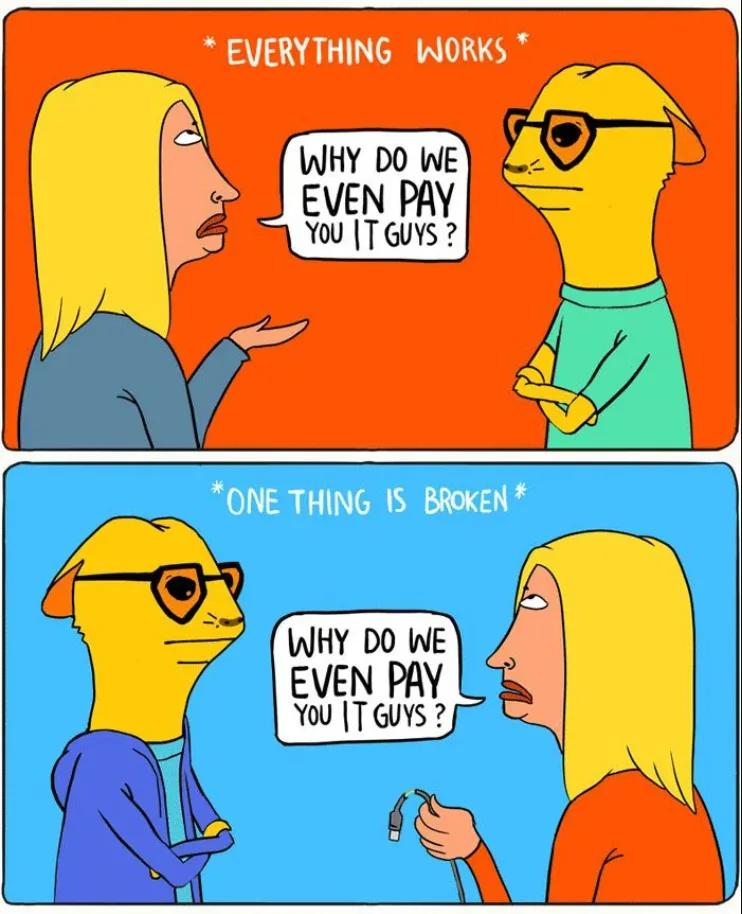
If your technology just works and you rarely need to contact your IT provider, it can be tempting to ask, “Do I really need to keep paying for this?”
It is a fair question. But it is based on a common misunderstanding of what managed IT services actually do and why they matter.
This blog will explain why your IT company is just as valuable when things are quiet, how to understand the unseen work being done in the background, and how to get even more value from your relationship with your provider.
The goal of good IT is not to be needed all the time. It is to be proactive and prevent problems before they ever reach you. If your day-to-day feels seamless, that is a sign your IT strategy is doing its job.
Of course, you should always feel comfortable reaching out with questions or issues. But ideally, you are not calling us because something broke. You are calling us because you want to plan your next move or use technology more strategically to support your goals.
A proactive IT partner gives you the stability to focus on your business and the tools to grow.
Think about other services in your life that are most valuable when they are not actively in your face.
If you walked into a spotless office every day, you would not ask your cleaning crew why you still pay them. You know their work is what keeps the mess away. The fact that you do not see trash piling up or dust everywhere is the very proof that the system is working.
Or consider accounting. Just because the books are balanced and taxes are filed without issue does not mean you did not need a professional. Their value shows in the fact that nothing went wrong.
Managed IT works the same way. You do not see the cyberattacks we block. You do not notice the hardware failures we prevent with patching and monitoring. You are not interrupted by outages because we maintain and manage your environment to avoid them in the first place.
That invisibility is not a lack of value. It is the evidence of value.
Here is a small sample of what a proactive IT partner is doing behind the scenes, whether or not you call in for help:
• Monitoring your network, devices, and systems 24 hours a day to catch issues before they cause downtime
• Rolling out security patches, system updates, and backup testing
• Keeping your email, data, and devices protected from phishing, ransomware, and unauthorized access
• Helping your business meet the cybersecurity and compliance standards required for insurance
• Documenting your environment so that any issue can be quickly resolved
• Tracking end-of-life hardware and software to avoid sudden disruptions
• Advising you on best practices and new technology that can give you a competitive advantage
If none of this is visible, that is a sign it is all working. Need proof? Read more about what tools we use to protect your business here
When IT works well, it can feel like nothing is happening. But that is the point.
Imagine walking into your office and seeing everything clean, stocked, and working. Would you say to your cleaning crew, “Why are we paying you? It is already clean.” Of course not. It is clean because they have done their job.
Now think about cybersecurity. Just because you have not had a data breach does not mean your protections are unnecessary. They are working silently in the background to make sure threats do not get through.
This same logic applies to managed IT. It is working because you are not seeing the problems.
Still wondering if you are getting your money’s worth? Here is a quick way to get a second opinion.
Open a tool like Microsoft Copilot or ChatGPT and paste in this prompt:
“My IT company provides support but I rarely contact them because nothing breaks. Am I wasting money or is that normal?”
This will give you a neutral, detailed response explaining what good IT service should look like. Chances are, it will reinforce exactly what you are experiencing now — a stable, secure setup where your team can focus on the work that matters.
If your IT provider offers more than break-fix support, you should be taking full advantage of what is included.
At Always Beyond, we bundle everything into one predictable monthly package. Our clients do not have to worry about unexpected bills or unclear support limits. You get access to a full-service IT team that is focused on your long-term success.
Here are a few ways to get more value from your MSP:
• Schedule regular check-ins or quarterly reviews to align IT with your business goals
• Ask how you can improve automation or efficiency in your day-to-day workflows
• Loop your IT provider into office moves, hiring plans, or new software decisions
• Use their knowledge to enhance security awareness, improve onboarding, and streamline remote work
If you are not sure what your plan includes, just ask. You might have access to more support than you realize.
Explore more in our blog on getting the best ROI from your IT spend
Many cyber insurance providers now require you to meet certain technical and security standards just to qualify for coverage. If you already have a policy or plan to apply, your IT environment needs to meet those requirements.
That usually includes things like secure backups, device encryption, multi-factor authentication, endpoint protection, and having a documented incident response plan in place. All of that is something your IT provider should help you implement and maintain.
If you were to drop your IT support, you could unintentionally fall out of compliance with your insurance provider and lose coverage in the event of a breach.
Not needing IT support every day does not mean your provider is not doing anything. In fact, it is usually a strong sign that your systems are being well cared for.
You are paying for expertise, monitoring, prevention, protection, and strategy. All of that allows your team to stay productive and your business to stay protected.
And when you consider that over 90 percent of cyberattacks begin with phishing and that 85 percent of Canadian SMBs have experienced at least one cyber incident in the last five years, being proactive is no longer optional.
The average cost of IT downtime is more than $5,600 per minute, or over $300,000 per hour. Every issue we prevent, and every minute we save, makes a difference.
If you want to explore how to get even more value out of your IT relationship, we would love to help. Let’s make sure your technology is not just running quietly in the background, but working actively to support your business.
See exactly how your current IT setup measures up to our Hack Free standards. Enter your business email to receive:
